So…finishing up my portfolio and I just thought I’d share a few things:
1. Person first language: people who are blind/ people who have low vision/ people who are visually impaired. However, keep in mind not everyone likes first person language or identifies as such. It’s a lot of politics and where you’re located, and tends to be tied to professions.
2. It’s a cane… not a stick
Side note: Please have your characters be safe travelers and use canes or guides some of the time, not just super powers all of the time. It’s hard enough for some young kids to use their canes without comparing themselves to Kanan Jarrus or Daredevil…
3.You don’t get super senses… but maybe you become more aware of what you’re sensing and differentiating what you’re sensing
4. As far as I’m aware and according to people I’ve talked to…touching faces is awkward and not effective
5. People who are congenitally blind may not turn to look at who’s talking because it is a learned skill that may need to be explicitly taught to them. However, people who become blind/lose their vision later in life may still turn to face who’s talking or face things that they are focusing on regardless of whether they can see it
6. Some people turn their heads at angles or appear to be looking away from you because they only have vision in that part of their eye that’s currently facing you. They can’t see you if they look straight on.
7. When you can see, you learn things whole-to-part. You, who are sighted, see a house, you think house. Then you learn door, window, roof, chimney, shutters etc. If you can’t see, you learn part-to-whole, and you need to rely on touch/hearing/smell/taste (when appropriate) to form a concept of something you might learn like this: door, smell of home, window glass, window frame, brick of a chimney, panels on side of the house etc. But then putting in all together as a house is difficult to conceptualize if you’re going off random pieces of the puzzle. You may need a tactile model or something to fill in the gaps if it’s something you’ve never seen and can’t touch in its entirety.
8. Cane stuff: Not everyone taps their cane when they use it. Most that I’ve been with don’t or if they do, they do not use it all the time. Think about it. You miss a lot of tactile feedback and there’s a greater risk of missing things to trip on. There are three types of formal cane techniques: two-point touch (the classic tapping side to side), constant contact, and verification technique. The first two the cane is held at the center of the body and the person moves it from side to side wide enough just so that it goes past their hips. As they move it to one side, their opposite foot steps forward. This gives someone the most protection when moving. Verification technique is when the person holds the cane low in their non-dominant hand and uses constant contact as they see possible obstacles/terrain changes in their path.
9. Counting steps is a myth. People don’t take even steps generally. Sometimes it’s easy to count doors if it’s a small number. But if you’re at school and you have to travel across the building, are you really going to count 20 doors? What if you bump into something and lose count? You’d have to start all over. Most people create landmarks for locations. It could be something like the door with the only bulletin board in the hallway. Or the door with the water fountain next to it. Or the door that is one door to the left directly across from the water fountain. Another thing here, is that you can kind of feel when you’re getting close to somewhere you’ve traveled to before. Like when you’re driving home and you feel like it’s been a while and your turn should be here, when suddenly the turn is here! That’s called time-distance estimation.
10. Most people are not totally blind. Only 2% of the population is visually impaired and only 2% of the population that is visually impaired is totally blind no light perception. This means that most people who are blind/visually impaired/have low vision can see something, and everyone is different and reacts different to their visual impairment and how they use the vision they have.
This got long and slightly ranty, which was an accident… but I hope someone finds it useful. And now that I have this off my chest, remember creative liberty is a thing 🙂
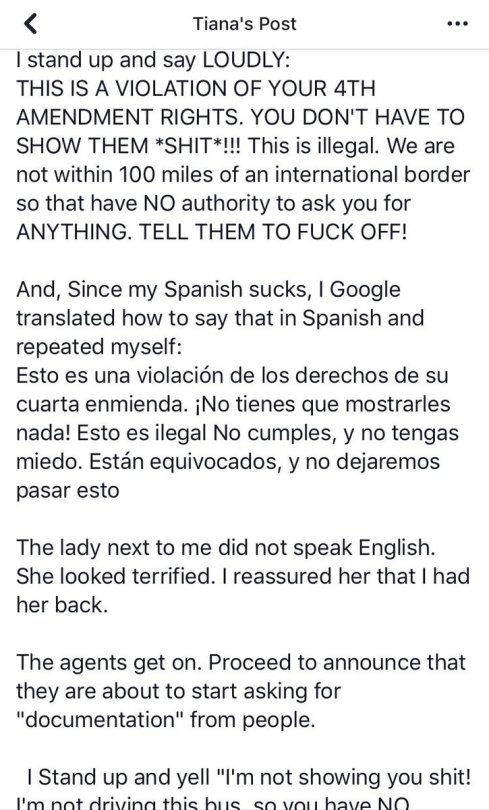
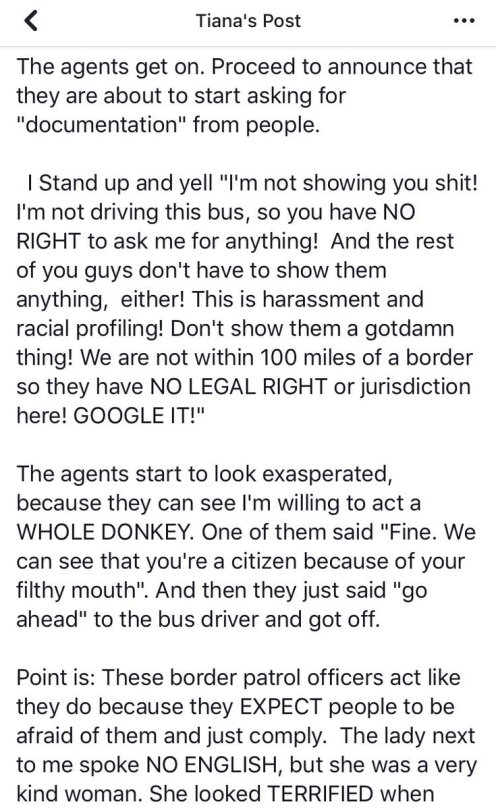
The people in this country are being treated like the people in nazi Germany did pre & during WWII. UNACCEPTABLE!!!!!!
boost this!
Fellow white people, stand up too. Don’t leave Black folks in the position of possibly getting shot for speaking up. Stand up and shield those who need it.
You know, I’ve tried writing material where the number of bisexual and gay characters present matches up with real-world demographics, but even that’s apparently enough to get folks passive-aggressively going “wow, is anyone in this setting straight?”, so basically my answer from now on is “no, not a single person in this setting is straight”.
(To be 100% clear, I’m a tabletop RPG designer, not a prose fiction author, so I’m not even talking about writing stories with gay or bisexual protagonists here – like, these are bring-your-own-protagonist scenarios. I’m just talking about setting material that has a reasonable number of gay and bisexual NPCs floating around the periphery, but even that’s a bridge too far. So screw it – no more heterosexual NPCs for you!)
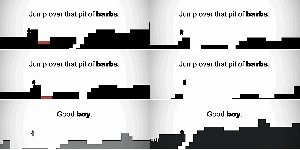
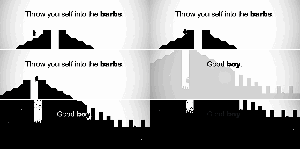
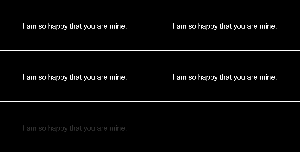
going to comment a little on this game: the overseeing voice talks as if it owns you, and defies your free will. if you follow its orders, you are praised, and the worldview becomes sharper and more detailed. if you don’t, you are chastised, and the world becomes more vague and difficult to navigate, but also more colourful and loud. it’s odd, and sort of eerie, but definitely interesting. take it as you will.
This game really unsettles me. It unsttles me that my first choice to obey, and when I played again and disobeyed, I got really emotional really fast. Failure hurt me more the more I disobeyed. It was… interesting to experience.
i’ve always said we are trained to obey more than to think.
holy shit. i reblogged this the first time without playing. then i played in and it is terrifying. i very much like this, but it will give you intense feelings.
What’s the game??
you obey everything the game tells you too, even jumping into barbs and basically killing yourself. if you dont youre chastised and even the scolding is terrifying
So, essentially, it’s a game that illustrates what it’s like to be in an abusive parents or an abusive relationship – and how it affects you emotionally. That is horrific and ingenious – the next time someone negates the affects of emotional abuse, I’ll take them to this game and let them come to their own conclusions.
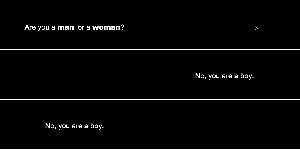
This game absolutely gets it. The most solid and reliable degradation is a gendered insult. The more you obey and co-operate, the better understanding you seem to have of your word, and things seem easier. But what really gets me is the contradiction. You are not allowed to have the correct answer. Are you a boy or a girl? The answer is no, I will give you the answer. even towards the end, your “praise” is “no, I will give you the answer. You earned this answer, but it is given to you by me.” Disobeying makes the world frightening and confusing and difficult, but beautiful in a world devoid of flavour.
great that it’s made by a fellow australian too
Reblogging this for later.
If anyone was looking for the name it’s called Loved
This game totally fucks with me every time I play it because it’s so damn real about what it’s conveying.
Let me tell you that the basic idea where obeying makes things easier, makes things clearer while disobeying makes things chaotic and ruins your sense of self: that shit is as real as it gets.
Obeying made life easy. The person you are isn’t, maybe, the person you want to be, but you have a sense of self. Making decisions is easier. You can at least predict how things will go, even when you hate it.
But once you start asserting yourself, that’s when it gets bad. Who you are gets questions and torn down time and time again. The process of getting out is so much harder as your ability to trust yourself wears to the point of being non-existence.
I had to have my abusive partner kick me out of the house twice before my ability to make the decision to crawl back was completely wiped.
It’s been almost 9 years since then. I have a sense of self again. But it was rough going for a long time.
For anyone who’s confused, the first comment contains a link to the game.
“Tu vs. Vous in French. via Alliance Francaise Sydney.also a good illustration of why natural language is so hard for computers (and humans) https://t.co/PMPTCmmxEZ “








 Organized Chaos